
How We Waterproof Where a Low-Slope Roof Meets Asphalt Shingles
A flat roof transition to sloped roof can become a serious leak point when waterproofing stops too close to the pitch change. Colorado snow, ice, meltwater and freeze-thaw cycles make proper membrane extension especially important.
A flat roof transition to a sloped roof needs continuous waterproofing carried from the low-slope roof well beneath the shingles. Published roofing guidance supports substantial membrane extension onto the steeper roof. Ernie’s Roofing uses a conservative Colorado transition detail designed around snow, ice, meltwater and avoiding unnecessary penetrations through the critical membrane area.
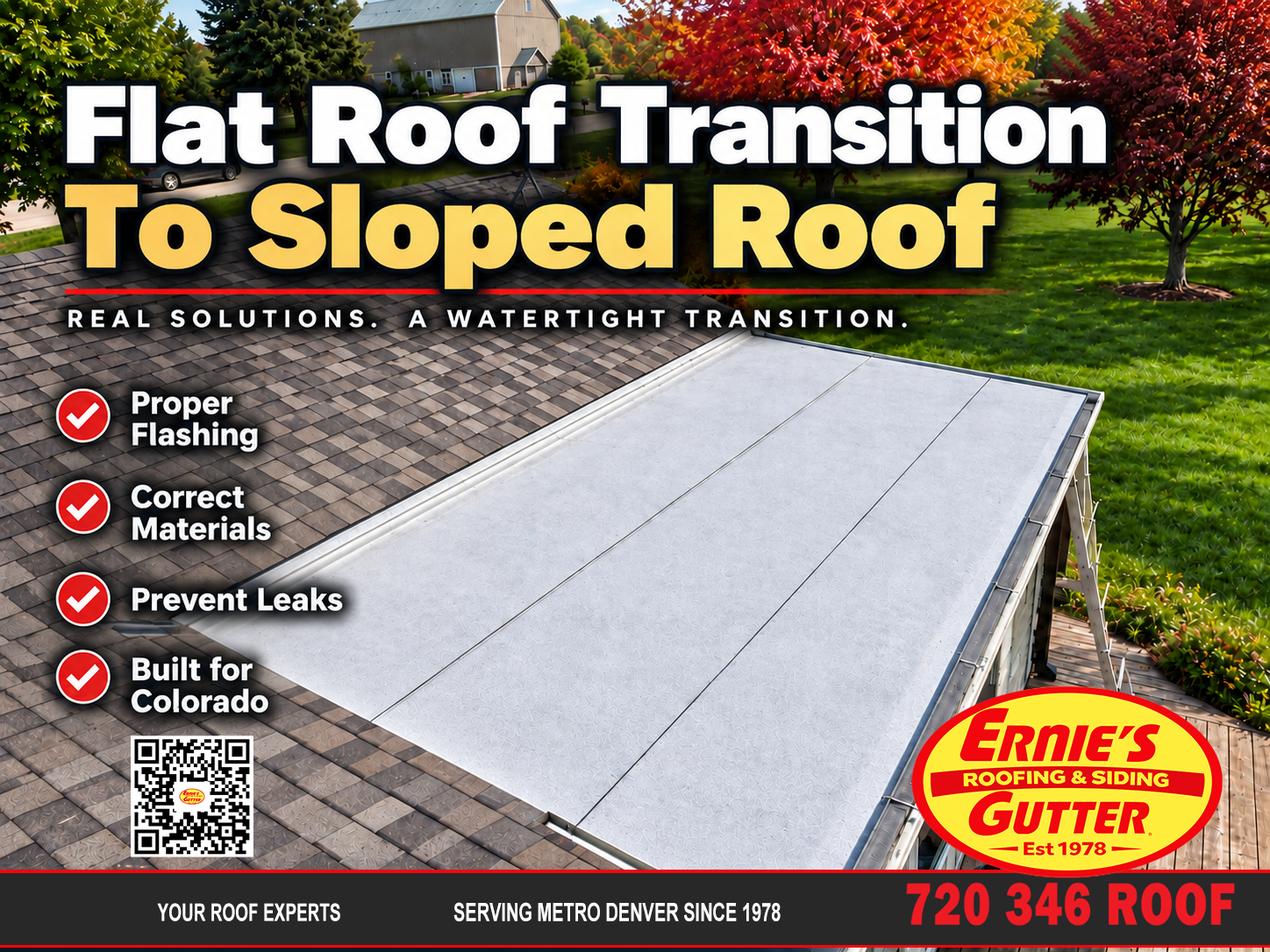
Why the Flat-to-Sloped Roof Transition Matters
Asphalt shingles and low-slope roofing membranes do different jobs. Shingles primarily shed water downhill. A properly selected low-slope membrane provides waterproofing where water drains more slowly and snow may remain on the roof longer.
Where those two systems meet, the waterproofing should not simply stop at the change in pitch. A properly constructed flat roof transition to sloped roof gives water beneath the first shingle courses a continuous protected path back onto the low-slope membrane.
Snow Can Collect Here
A change in roof pitch can create an area where snow remains longer or accumulates differently than it does on the steeper roof.
Meltwater Can Back Up
Snow can melt during warmer periods while colder areas remain frozen. Water at the transition may not behave like ordinary summer rainfall.
Colorado Freeze-Thaw Repeats
Snow, melting, refreezing and another storm can repeatedly expose a weak transition. We treat this area as a waterproofing detail rather than only a shingle detail.
How Far Should Waterproofing Extend Up the Sloped Roof?
The required distance depends on the roofing system and roof geometry. Published industry guidance calls for substantial waterproofing beyond the pitch change. Ernie’s Roofing generally prefers approximately 28 inches or more of protected membrane run-up for this Colorado transition detail when the roof configuration and specified materials allow it.
Published guidance gives us a useful starting point. The Asphalt Roofing Manufacturers Association addresses lower-slope-to-steeper-slope transitions and recognizes the need to continue waterproofing onto the steeper roof because water can accumulate near the change in pitch.
Published modified-bitumen details likewise show the low-slope roofing system continuing beyond the transition rather than ending directly at the pitch break.
Flat Roof Transition To Sloped Roof Installation Guide
Installing a flat roof transition to sloped roof correctly begins before the first shingle reaches the pitch change. The following explains the installation logic behind our field approach. Exact products, adhesives and fastening requirements still need to match the roofing system being installed.
Inspect the Deck and Roof Geometry
Determine the actual low-slope pitch, steeper roof pitch, deck condition, drainage direction and where snow or water is likely to collect before covering the transition.
Install the Low-Slope Waterproofing First
The modified-bitumen or other specified low-slope membrane is installed as the waterproofing system. It does not simply terminate at the pitch break.
Carry the Membrane Through the Transition
The waterproofing continues across the change in pitch and well onto the steeper roof deck, creating a continuous secondary water-management plane beneath the shingles.
Create a Protected Transition Zone
Ernie’s Roofing treats the critical modified-bitumen run-up as a no-unnecessary-penetration area. We do not casually drive shingle nails through this membrane simply because that would be the normal nail location farther up the roof.
Use Compatible Bonding Materials
Where shingles contact modified bitumen, the bonding material must be compatible with the membrane system. We do not assume every roofing cement or sealant is compatible with every modified-bitumen product.
Bond the Shingles Through the Protected Area
Our field method uses substantial controlled bonding through the protected transition area. The objective is to secure the shingle courses while avoiding unnecessary penetrations through the waterproofing directly beneath them.
Resume Normal Fastening Above the Transition
Once the shingles are fully beyond the protected membrane transition and back in the normal steep-slope roof field, conventional fastening follows the requirements of the specified shingle system.
Why We Avoid Shingle Nails Through the Critical Transition Membrane
After roughly 45 years of dealing with Colorado roofs, this is one detail Ernie does not like gambling with.
A nail is normally an essential part of asphalt-shingle installation. At this transition, however, a nail through the waterproof membrane creates a penetration in the very layer we are relying on if snow, ice or backed-up water reaches beneath the shingles.
That does not mean every published roofing system prohibits every fastener through every membrane. Some approved systems are designed around properly detailed fastener penetrations. It means Ernie’s Roofing treats unnecessary shingle penetrations through this critical transition membrane as an avoidable future leak path.
Normal Steep-Slope Roof Field
Shingles are mechanically fastened according to the specified roofing system, with water normally shedding down the shingle surface.
Critical Transition Zone
Snow, ice and backed-up water can make this area less forgiving. Our goal is to preserve the continuity of the waterproof membrane beneath the shingles.
Why Colorado Snow and Ice Change the Detail
Imagine several inches of snow on the roof. Part of it melts during the day. Temperatures fall and some of that moisture freezes. Then another storm adds more snow on top.
The transition is now dealing with layers of snow, ice and meltwater rather than one clean rain event.
Water can move beneath shingles when drainage is restricted by ice or when wind pushes moisture upslope. If water reaches beneath the shingles at a flat roof transition to sloped roof, we want it landing on continuous waterproofing and draining toward the low-slope membrane rather than reaching the roof deck.
A transition that performs during ordinary rain can still become vulnerable during snowmelt and refreezing. The safer approach is to design the transition around realistic winter water conditions, with enough waterproof membrane extension to keep backed-up moisture away from the roof deck.
Who Knew? Somebody Else in Internet Land Was Thinking Along the Same Lines
After decades of seeing what Colorado snow and ice can do at these transitions, it was interesting to find independent building professionals discussing many of the same trouble spots.
Doug Horgan, writing for the Journal of Light Construction, discusses steep-slope-to-low-slope transitions as areas where snow accumulation, ice damming, wind and backed-up water need to be considered.
His related work on low-slope roofing details also addresses failures around intersections and penetrations. That gets very close to the field problem we are trying to prevent: too little waterproofing at a vulnerable transition combined with penetrations in the membrane.
That does not make Ernie’s exact installation method a JLC specification. It does show that the underlying concern—snow, ice, backed-up water, adequate membrane extension and careful treatment of penetrations—is recognized beyond one Denver roofing company.
Read Doug Horgan’s Steep-Slope to Low-Slope Transitions and Low-Slope Roofing Details That Work at the Journal of Light Construction.
Signs a Flat-to-Sloped Roof Transition May Be Failing
Leaks During Snowmelt
A transition that remains dry during ordinary rain but leaks when snow begins melting deserves a closer inspection.
Repeated Patching
Layers of old roofing cement around the pitch break can indicate that the underlying transition was never corrected properly.
Shingles Nailed Very Low
Fasteners close to the change in pitch deserve attention because the waterproof membrane may be directly underneath them.
Short Membrane Run-Up
If the low-slope waterproofing barely disappears beneath the first shingle courses, there may be limited protection against backed-up water.
Interior Water Staining
Ceiling or wall staining near a patio, porch or addition can sometimes trace back to the roof transition above it.
Snow Piling at the Pitch Break
Roof geometry that repeatedly holds snow at the transition deserves a waterproofing detail designed for that exposure.
Can a Bad Roof Transition Be Repaired?
Often, yes. But smearing more roofing cement over the visible joint is not automatically a repair.
When repairing a flat roof transition to sloped roof, enough shingles may need to be removed to determine how far the membrane actually extends, inspect the roof deck, identify previous penetrations and determine whether the existing low-slope membrane remains serviceable.
If the membrane has deteriorated or repeated leakage has damaged the roof deck, the scope can become larger. That is why we inspect the assembly before promising that a simple patch will solve it.
Have a Flat Roof Meeting a Shingle Roof?
If you are seeing leakage, snowmelt problems or an older transition detail you do not trust, Ernie’s Roofing can inspect the assembly and explain what is actually happening before recommending a repair.
Ernie Says
Don't judge this transition by how it performs on a sunny day.
The real test is what happens after snow sits there, melts, freezes again and then gets another storm on top of it. I would rather carry the waterproofing farther up the roof and keep unnecessary nails out of the critical transition than find out later that we stopped a few inches too soon.
That comes from roughly 45 years of seeing what works—and what eventually leaks—on Colorado roofs.
Flat Roof Transition To Sloped Roof Questions
How should a flat roof transition to a sloped shingle roof?
A flat roof transition to sloped roof should carry the low-slope waterproofing through the pitch change and well beneath the shingles so water reaching below the shingle surface still lands on a waterproof layer.
How far should the membrane extend up the sloped roof?
The required distance depends on the roofing system and roof geometry. Ernie’s Roofing generally prefers approximately 28 inches or more of protected membrane run-up for this Colorado transition detail when the specified roofing system allows it.
Can shingles be nailed through modified bitumen?
Some published roofing systems permit properly detailed fasteners through compatible membranes. Ernie’s Roofing takes a more conservative approach at this critical transition and avoids unnecessary shingle nails through the modified-bitumen run-up.
Why would a roof transition leak during snowmelt but not rain?
Snow and ice can restrict normal drainage and allow meltwater to move beneath shingles. Ordinary rain often drains more quickly, so a marginal transition can appear fine until winter conditions expose it.
Can ice dams cause leaks where two roof slopes meet?
They can. Snow accumulation and refreezing can restrict drainage near a pitch change and allow water to move beneath shingles. Continuous waterproofing underneath provides an additional layer of protection.
What roofing material is used on the low-slope section?
Several systems can be appropriate depending on the roof. This guide focuses primarily on modified-bitumen transition principles. The actual membrane should match the roof slope, substrate, drainage conditions and manufacturer requirements.
Can regular roofing cement be used on modified bitumen?
Do not assume that it can. Adhesives and flashing cements should be compatible with the specific membrane. Product instructions need to be checked before applying one roofing material directly to another.
Does a leaking transition mean both roofs need replacement?
No. A localized transition may be repairable when the surrounding roofing and roof deck remain serviceable. Deteriorated membrane or repeated water damage can increase the repair scope.
Is a 2:12 roof considered a low-slope roof?
A 2:12 roof is at the low end of asphalt-shingle applications and requires special water-management considerations. Depending on the roof, a membrane system designed specifically for low-slope conditions may be more appropriate.
Why is this transition especially important in Denver?
Denver roofs experience snow, ice, strong sun and repeated temperature changes. A transition has to manage rainfall as well as snowmelt and refreezing conditions that can expose weaknesses in short or poorly detailed waterproofing.
Sources and Technical References
This guide combines published roofing guidance with Ernie Ruiz’s field experience working on Colorado roofs. Where Ernie’s Roofing intentionally uses a more conservative field detail than a published minimum, we identify it as our field practice rather than presenting it as a universal manufacturer requirement.
- Doug Horgan, Journal of Light Construction — Steep-Slope to Low-Slope Transitions
- Doug Horgan, Journal of Light Construction — Low-Slope Roofing Details That Work
- Asphalt Roofing Manufacturers Association — Use of Self-Adhering Membranes as Underlayments in Steep Slope Roofing
- Asphalt Roofing Manufacturers Association — Installation of Asphalt Shingles on Lower Sloped Roofs
Need Your Roof Transition Checked?
If you are unsure whether your flat roof transition to sloped roof has enough waterproofing beneath the shingles, Ernie’s Roofing can inspect the transition and explain what is there before recommending the next step.