
THIRD-GENERATION FAMILY CONTRACTOR · SINCE 1978
Roof Leak Or Condensation?
Water on your ceiling does not always mean rain came through the roof. Before approving a repair, find out whether moisture entered from outside, escaped from inside, or came from another source. Ernie’s Roofing helps Denver homeowners understand what the findings actually support.
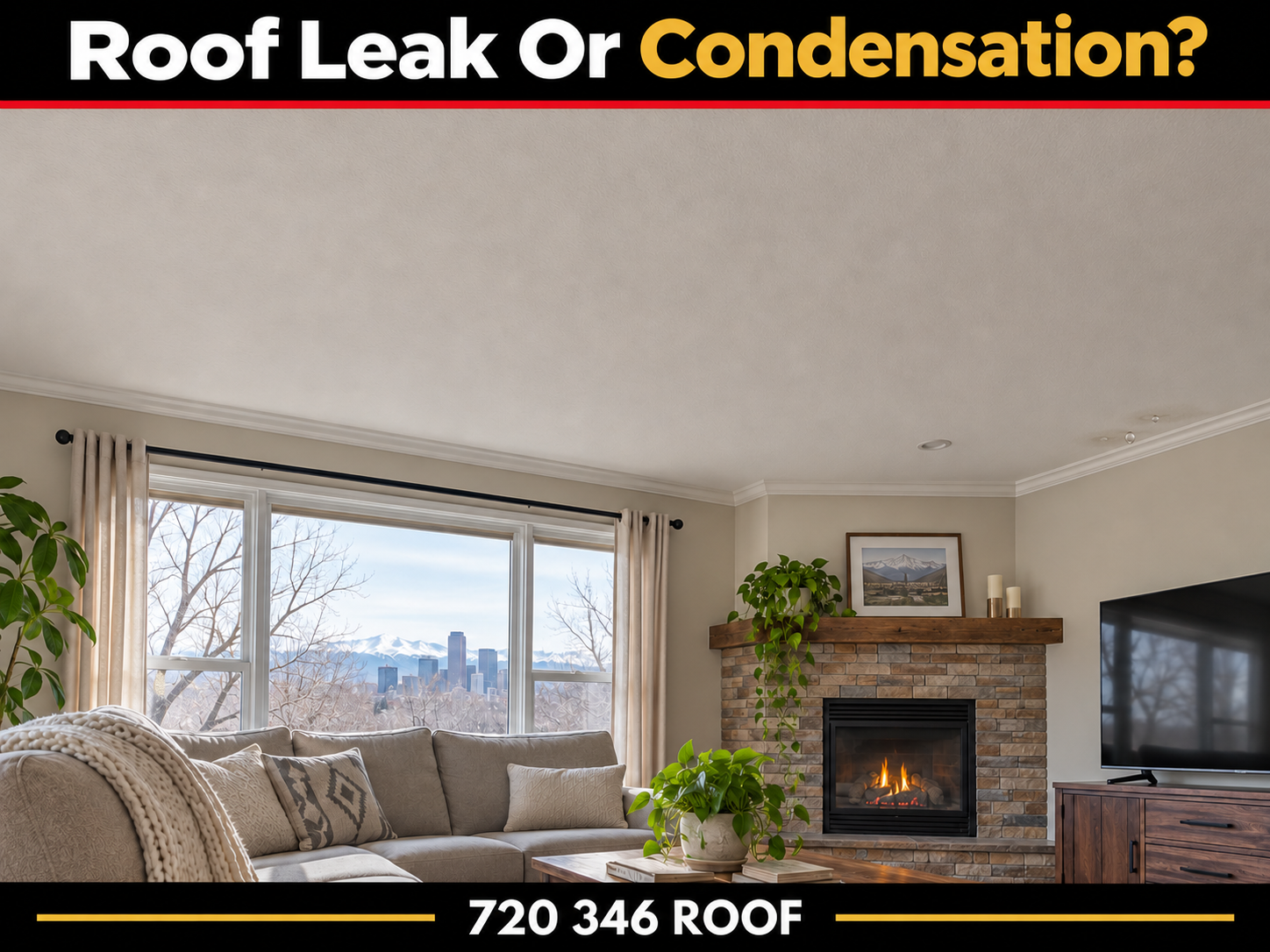
How Can You Tell A Roof Leak From Condensation?
A roof leak lets outside water enter through a defect. Condensation forms when moist air meets a surface below its dew point. Weather, moisture patterns, exhaust routing, and inspection findings help distinguish them. Neither a ceiling stain nor water without recent rain proves the source. Both problems can occur together.
Start With The Water Source, Not The Ceiling Stain
A few droplets appear above the television. A bathroom ceiling develops a small damp spot. Your first thought is understandable: the roof must be leaking. But the mark tells you where water became visible, not necessarily where it started. Water can travel along framing, collect on a cold surface, or soak through insulation before reaching the drywall.
The first useful question is when the moisture appears. Write down recent rain, snow, cold nights, warmer afternoons, showers, cooking, and heating or cooling use. You are looking for a pattern that guides the inspection. One coincidence is not enough to establish a cause, and an old stain does not prove water is still entering.
For Denver homeowners, the distinction matters because the wrong repair can leave the source untouched. Replacing shingles will not reconnect a bathroom exhaust duct. Adding a vent will not repair failed flashing. Painting the ceiling before the moisture source is corrected can hide the evidence without resolving the problem underneath.
Our approach starts with the roof, the accessible attic, and the history of the symptom. When the findings point to plumbing, HVAC equipment, or a building-air-leakage problem, that needs the appropriate trade or further evaluation. The goal is a defensible explanation, not forcing every ceiling spot into a roofing job.
Roof Leak Or Condensation: Clues Worth Investigating
A roof leak involves water entering through the roof assembly. Condensation involves water vapor becoming liquid on a sufficiently cold surface. In freezing conditions, that moisture may collect as frost. When temperatures rise, the frost can melt and drip. Neither explanation can be confirmed by the appearance of the living room ceiling alone.
| What You Notice | What To Investigate |
|---|---|
| Water during rain or roof snowmelt | Roof covering, flashing, penetrations, water paths, and ice-related backup |
| Drips after cold weather followed by a thaw | Attic frost, indoor moisture sources, air leakage, and possible snowmelt entry |
| Moisture repeatedly follows showers or cooking | Exhaust operation, connected ductwork, outdoor discharge, and ceiling air leakage |
| Staining near a pipe, vent, or skylight | Exterior weatherproofing and interior air-sealing or condensation details |
| Dampness with no recent rain | Condensation, plumbing, HVAC drainage, retained water, and melting snow or ice |
Localized staining around a penetration can help trace an entry path. More broadly distributed droplets or frost can raise concern about moisture condensing in the attic. Those are investigation clues, not a guaranteed split. Condensation can stain roof sheathing, and a roof leak can wet insulation and drywall. Either problem can leave similar damage.
If there has been no rain, condensation moves up the list of possibilities. It does not become the only possibility. Snow can melt after a storm has passed, a pipe can leak at any time, and equipment can produce water independently of the weather. A useful inspection checks the alternatives before declaring the answer.
How Everyday Indoor Moisture Reaches The Attic
Showers, cooking, laundry, and normal living add moisture to indoor air. That moisture does not need to look like a cloud of steam to matter. If indoor air travels through gaps into a colder attic, it can reach surfaces cold enough for water to form. Heat alone does not create the water; moisture and surface temperature both matter.
Dew point means the temperature at which air with a particular moisture content becomes saturated. A cold drinking glass provides a familiar example: water forms on the outside because moisture in the surrounding air meets the cold surface. In an attic, the cold surface may be the underside of roof decking, framing, metal fasteners, or a duct.
Ceiling openings can provide air paths. An attic hatch, wiring opening, pipe chase, recessed light, or poorly sealed connection around a bathroom fan may allow indoor air to escape. These openings are different from a hole in the roof covering. The inspection needs to distinguish movement through the ceiling from weather entering through the roof.
A dry outdoor climate does not guarantee a dry attic. Conditions inside a house can differ substantially from the outdoor air. The useful questions are where moisture originates, how it travels, what surface it reaches, and how the assembly dries. Guessing from the city’s climate or the season alone leaves too much unexplained.
A Running Fan Does Not Prove Moisture Leaves The House
This is one of the first details Ernie wants homeowners to understand. A bathroom fan may turn on at the switch and make the expected sound while its duct is disconnected, damaged, blocked, or ending inside the attic. In that situation, the fan can move shower moisture out of the bathroom and deposit it somewhere else inside the building.
A ducted kitchen hood or microwave exhaust also needs a suitable route to the outdoors. Some appliances are intentionally configured to recirculate through a filter back into the room. That is not the same as exhausting cooking moisture outdoors. A fan motor, filter, or grille by itself does not establish which configuration you have.
Look for the intended outdoor termination from a safe location. It may be a low hood-shaped roof cap on a flashing base, or a wall cap. Cap designs vary, and it may not sit directly above the room it serves. If you cannot identify an exit, ask someone to trace the duct rather than assuming it ends in the attic.
Even a visible cap does not prove the fan is connected to it. A professional should confirm the route, connections, suitable duct arrangement, termination, and operation. Bathroom exhaust, kitchen exhaust, plumbing vents, attic ventilation, and combustion flues have different functions. They are not interchangeable, and an ordinary fan cap is not a substitute for a furnace exhaust termination.
If the bathroom has no effective exhaust or the kitchen only recirculates, that is useful information for the moisture investigation. It does not prove those conditions caused a particular ceiling spot. Record what is present, explain when the moisture appears, and let the inspection connect the evidence to a specific correction.
Hear The Fan? Check Where The Air Goes
Photograph the ceiling marks and any outdoor exhaust cap you can see safely. If the route is unclear, contact Ernie’s Roofing to discuss the symptoms and the appropriate next step.
Air Barriers And Vapor Retarders Do Different Jobs
People often use “vapor barrier” to describe any layer that should stop attic moisture. The distinction is worth explaining. An air barrier controls air moving through openings. A vapor retarder slows water vapor passing through a material. A material may serve both purposes in a particular assembly, but only when its installation and connections support those functions.
A ceiling can include a vapor-retarding layer and still have unsealed gaps around a hatch, pipe, or fixture. Moist air can bypass the layer through those openings. Conversely, installing plastic without understanding the existing roof and ceiling assembly can interfere with drying. The answer is not automatically to add another layer wherever water appears.
Air sealing also needs to respect electrical equipment and required clearances around heat-producing components. This is not a recommendation to spray foam around every pipe or light. A qualified evaluator should identify the actual air path and specify suitable materials and details. The correction should fit the house rather than follow a one-product rule.
Check The Whole Assembly Before Adding More Vents
In a conventional vented attic, intake and exhaust need a usable airflow path. Insulation pushed into the eaves can obstruct intake. Baffles can maintain a passage between insulation and the roof deck where the design calls for one. But a clear passage does not correct a bathroom duct that is actively delivering moisture into the attic.
Review moisture sources, ceiling air leakage, insulation coverage, and ventilation together. Adding exhaust alone may leave the source untouched. A powered fan also needs an appropriate air supply; the evaluation should consider where replacement air comes from. Equipment selection should follow the findings, not lead them.
Not every roof is built with the same attic design. An unvented roof assembly or a cathedral ceiling requires a different evaluation from an open, vented attic. Do not cut new vents simply because a neighboring home has them. Our attic ventilation service page explains the broader review, while this article focuses on identifying the water source.
What You Can Record Safely Before The Visit
Start inside the occupied room. Take an overview showing where the mark sits relative to walls, the bathroom, or other nearby rooms. Then take a closer photograph. Note whether it is damp now, whether the area has changed, and when you first noticed it. Keep the original photos so dates and context remain available.
Write down fan use, shower timing, cooking, humidifier use, and the weather when the moisture appears. If you already have an indoor humidity reading, record it with the room and time. One number does not establish the cause, and there is no single humidity setting that suits every house and every outdoor temperature.
Photograph an outdoor cap only from ground level or another safe position. Do not climb onto a wet roof, step between attic framing, move insulation around electrical equipment, or open a flue to obtain evidence. A sagging ceiling or water near electrical equipment calls for prompt professional attention and keeping people clear of the affected area.
You can tell us what the fan does without taking it apart. Does it turn on? Does the problem follow its use? Can you identify a likely wall or roof exit? Those observations help plan the visit. They do not replace checking that air actually travels through a connected, suitable duct to the outdoors.
Questions To Ask Before Approving The Correction
Ask the person evaluating the problem to show what supports the recommendation. The explanation should identify the suspected source, the route moisture takes, and the affected materials. An inaccessible area should be described as uncertain. A photograph of a stain does not prove what is happening on the other side of the material.
- What evidence points to outside water, indoor condensation, or another source?
- Have you traced the bathroom or kitchen exhaust all the way outdoors?
- Which ceiling openings, insulation details, or ventilation paths need attention?
- What could you not inspect, and what further evaluation is proposed?
- Does the scope address the source, wet materials, and follow-up checks?
- What additional work needs separate written approval?
If failed flashing is documented, a focused roof repair may address the entry point. If the exhaust route is defective, the correction needs to address that route. Wet materials may need drying or further assessment after the source is controlled. A stain alone does not establish that the roof requires replacement.
For a hypothetical example, consider two bathrooms with similar ceiling spots. One has rainwater tracking around a roof penetration. The other has a disconnected fan duct and moisture appearing after showers in cold weather. Similar room damage can require different work. The investigation, rather than the appearance of the ceiling, should determine which correction is justified.
Source control and damage assessment should remain separate decisions. Ask which materials are wet now, which marks appear historical, and what evidence supports replacement rather than drying or monitoring. Where contamination or significant material deterioration is suspected, ask who is qualified to evaluate it. Do not assume that fresh paint, a new fan, or a newly installed vent resolves all resulting damage. Keep the documentation from the first visit so any follow-up can compare conditions rather than start from memory. A useful recommendation explains both what the proposed work should accomplish and what it cannot establish.
Ask how the result will be checked under relevant conditions and what would trigger another visit. Dry weather immediately after a roofing repair may not test the same conditions that produced the problem. Likewise, reconnecting a duct does not instantly dry soaked insulation. A clear scope separates correcting the source from assessing the remaining damage.
Document The Damage And Keep Coverage Questions Separate
Keep The Findings Together
Save photos, the moisture timeline, inspection findings, and the written scope. Ask the contractor to distinguish observed damage from suspected concealed conditions. Use our insurance claim support information for the roofing documentation side.
Ask Your Insurer About Coverage
The cause, policy wording, and circumstances matter. This article does not establish coverage for a leak, condensation, or resulting damage. Coverage and claim payments are determined by your insurer under the policy; a contractor’s recommendation is not a payment guarantee.
Ernie’s Roofing is a third-generation, family-owned contractor serving Denver and the Front Range since 1978. Tell us when the water appears and send the photographs you can collect safely. We can discuss the roofing concern and whether the findings call for roofing work, exhaust correction, or evaluation by another qualified trade.

Ernie Says
A fan can turn on and still leave the moisture inside the house. That air needs a connected path to the outdoors.
Find The Source Before Choosing The Repair
Roof leak or condensation? Bring the timing, the photos, and your questions. Contact Ernie’s Roofing to discuss what needs checking before you approve the work.
Roof Leak Or Condensation FAQs
Can condensation look like a roof leak?
Yes. Moisture can condense on cold attic surfaces, collect as frost, and drip when temperatures rise. That water may reach insulation and drywall. A roof leak can wet the same materials, so the pattern and inspection findings matter more than a ceiling stain alone.
Does water without rain prove it is condensation?
No. Condensation is one possibility, but melting roof snow, retained water, plumbing leaks, and HVAC drainage can also produce moisture without recent rain. Record the timing and have the likely sources investigated before choosing a repair.
Can condensation form on roof decking?
Yes. Condensation can form on the underside of cold roof sheathing, framing, and metal fasteners. It is not limited to drywall or insulation. Staining on decking therefore does not, by itself, prove outside water entered through the roofing.
Why does moisture sometimes appear after a shower?
Showering adds moisture to indoor air. An ineffective exhaust route or ceiling air leakage may allow that moisture to reach colder areas. Timing after showers is a useful clue, but the fan, duct, outdoor termination, and other possible water sources still need checking.
If my bathroom fan runs, is it exhausting outdoors?
Not necessarily. The motor may run even when a duct is disconnected, blocked, damaged, or terminating in the attic. Verify the complete route and outdoor discharge. Sound at the grille does not establish that the air leaves the house.
Does every bathroom fan need a roof cap?
Not every exhaust route goes through the roof. A suitable wall termination may be used where the installation allows it. Ask someone to trace the actual route. A roof cap that is visible from outside does not prove the fan is connected to it.
Does a recirculating microwave remove cooking moisture outdoors?
No. A recirculating configuration returns air to the kitchen through its filter rather than exhausting it outdoors. Some appliances can be configured for outdoor exhaust, but the correct arrangement depends on the appliance and installation. Confirm the configuration rather than assuming from the fan noise.
Will adding attic vents solve the problem?
Not automatically. An appropriate correction may involve indoor moisture sources, connected exhaust ducts, ceiling air sealing, insulation, and ventilation. The roof assembly also matters: a conventional vented attic is different from an unvented roof. Diagnose the source before choosing equipment or cutting vents.
What is the difference between an air barrier and a vapor retarder?
An air barrier controls air movement through openings. A vapor retarder slows water vapor passing through a material. A layer can perform both roles in some assemblies, but gaps can still let moist air bypass it. Corrections should account for the existing construction and drying path.
What should I send Ernie’s Roofing before an evaluation?
Send a room overview, close-up photos of the affected ceiling, and a short timeline covering weather and shower or cooking use. Include a ground-level photo of any likely outdoor exhaust cap if available. Do not climb onto the roof or enter unsafe attic areas to gather pictures.
Related Reading
- Attic Ventilation
- Roof Vent Repair Denver
- Roof Still Leaking After Repairs
- Repair Or Replace Roof
- Roof Inspection Denver
For independent technical background, see the Building America guide to cold-weather attic condensation and the Department of Energy’s existing-attic air-sealing guidance. These references explain general principles; they do not diagnose a particular home.