
Chimney Leak Repair Denver
Family-owned since 1978. Third-generation roofing experience focused on finding the water entry point and explaining the repair your home needs.
Chimney leak repair Denver homeowners need starts with identifying whether water enters through roof flashing, a failed termination seal, or the chimney itself. Ernie’s Roofing evaluates step flashing, counterflashing, nearby shingles, and uphill drainage to recommend a targeted repair based on the actual condition of the roof-to-chimney connection.
Why Water Shows Up Around A Chimney
A stain beside your fireplace does not tell you exactly where the leak began. Water can enter uphill, travel along wood or framing, and become visible beside the chimney. Chimney leak repair starts with tracing that path before choosing where to work.
If this is your first time hearing this, flashing is the shaped metal that directs water across a vulnerable joint. Around a chimney, several pieces work together. A failure in one corner, overlap, or termination can allow water beneath otherwise serviceable shingles.
Loose Or Damaged Metal
Separated counterflashing, rust holes, damaged corners, and poor overlaps can open a path for rain. A patch may hide the opening while leaving the failed assembly underneath.
Failed Upper Seal
A surface-mounted flashing detail relies on a properly secured and sealed upper termination. Cracked sealant, poor adhesion, or movement can let water run behind the cover metal.
Chimney Or Uphill Entry
Cracked masonry, crown defects, cap problems, and restricted drainage behind the chimney can produce similar symptoms. Roof flashing work alone will not correct every chimney leak.
5 Warning Signs Worth Checking
- New or spreading ceiling stains near the chimney.
- Drips that return during rain or snowmelt.
- Visible gaps or loose metal at the chimney connection.
- Cracked or separating sealant along the upper flashing edge.
- Repeated patches that have not stopped the leak.
Repeated wetting can affect roof decking, insulation, framing, and interior finishes. Waiting can expand a limited flashing repair into removal of damaged materials and interior restoration. An inspection helps establish the scope before more water enters.
Step Flashing Underneath. Counterflashing Over The Top.
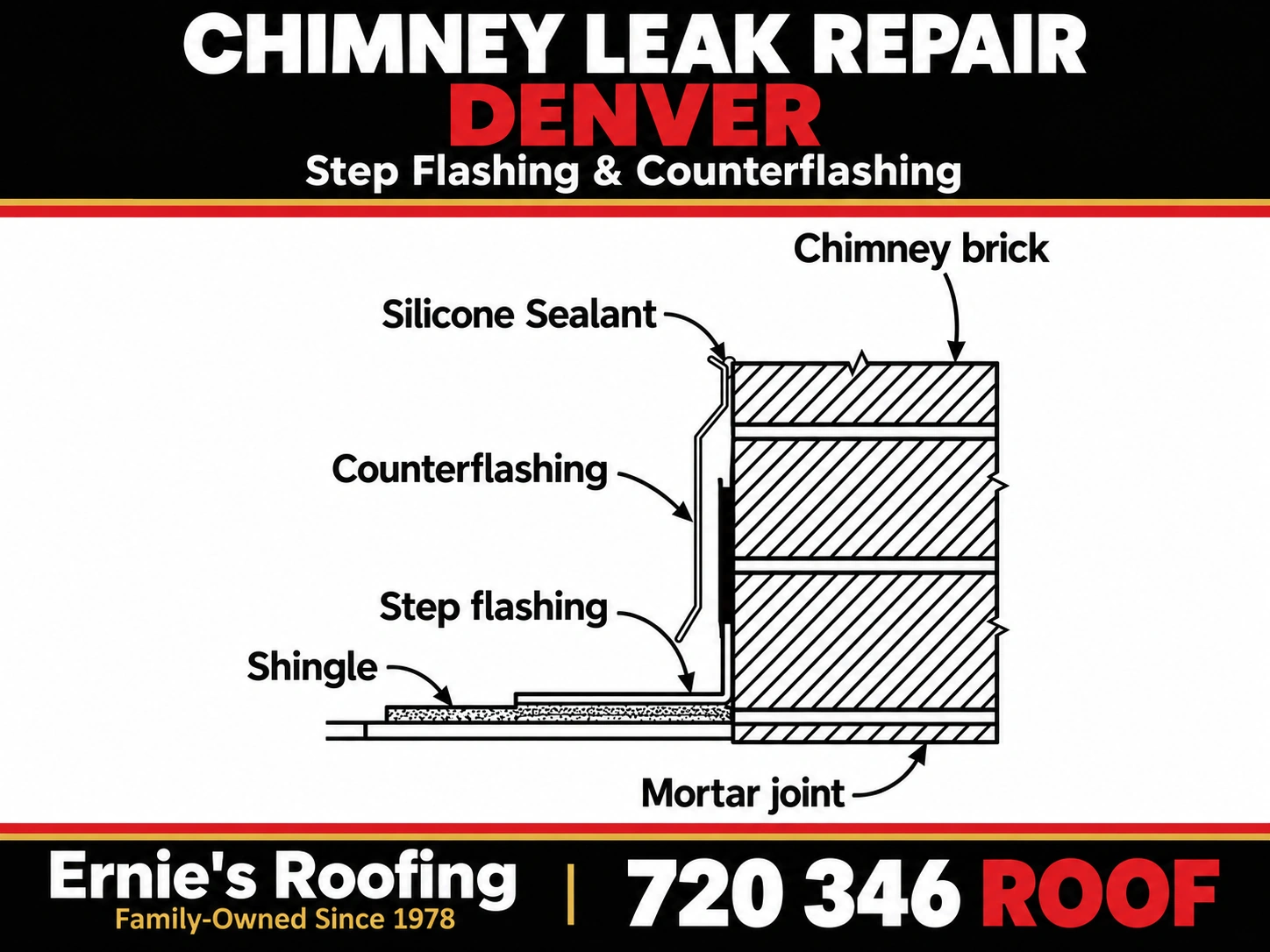
The layering matters. Our diagram shows the counterflashing outside the upright leg of the step flashing. Each component has a separate job, and the completed assembly must shed water back onto the roofing.
Step Flashing Follows The Shingle Courses
Individual L-shaped metal pieces are interwoven with the shingles as the roof rises beside the chimney. One leg lies on the roof; the other turns up against the chimney. The pieces overlap uphill so runoff moves toward the roof surface.
Missing pieces, reversed laps, poorly placed fasteners, or damage during earlier work can interrupt that drainage path. Smearing the outside with roof cement does not restore the correct layering.
Counterflashing Protects The Upright Legs
Counterflashing covers the upper edges of the step flashing. In the surface-mounted arrangement illustrated here, the upper portion is attached against the chimney and its termination is sealed. Other approved assemblies may terminate in a masonry joint.
The actual attachment, overlap, metal, and sealant must suit the chimney and roofing system. The diagram explains the relationship between the pieces; it is not a dimensioned installation specification.
The drawing identifies a sealant joint. It does not mean every tube labeled silicone is suitable for every roof. The repair needs a compatible exterior sealant approved for the actual metal, masonry, exposure, and installation detail. Proper surface preparation and sound flashing remain essential.
For a manufacturer’s explanation of chimney flashing and water diversion, see GAF’s chimney cricket guidance.
Does The Same Chimney Leak Keep Coming Back?
A recurring leak deserves a look beneath the previous patch. Tell us when it leaks, what work was done, and whether the problem changes with wind, rain, or snowmelt.
What A Lasting Chimney Flashing Repair May Require
The scope should follow the failure. Sound metal with one failed termination needs a different repair from missing step flashing or deteriorated wood beneath the shingles.
Termination Repair
Where the assembly remains sound, the work may involve removing failed sealant, preparing the surfaces, correcting attachment, and resealing the appropriate joint.
Flashing Reconstruction
Damaged or incorrectly installed metal may require opening nearby shingle courses, replacing affected components, and rebuilding the overlapping water-shedding detail.
Underlayment And Decking
Exposed areas are checked for damaged roof decking and defective membrane transitions. Concealed damage can change the scope once the assembly is opened.
The Back Of The Chimney Matters
The uphill side receives runoff from the roof above. Debris, defective backpan flashing, and poorly integrated underlayment can allow water to collect or enter. A chimney cricket is a small raised roof section that diverts water around the chimney where required or appropriate.
Adding membrane or sealing a visible edge will not correct a detail that still channels water into the wrong place. The inspection needs to follow the drainage path through the entire uphill connection.
Roof Work And Masonry Work Are Different
A cracked crown, deteriorated mortar joint, or defective chimney cap can admit water above the roofing. We identify whether the evidence points to the roof connection or whether chimney or masonry evaluation is also needed.
That distinction prevents paying for flashing work while the actual entry point remains higher on the chimney. Any separate specialist work should be identified clearly in the scope.
Sealant Repair Or Flashing Replacement?
| Observed condition | What needs evaluation |
|---|---|
| One open upper termination; surrounding metal appears sound | Attachment, surface preparation, sealant compatibility, and whether water has already entered behind the cover. |
| Repeated coatings, rust holes, missing pieces, or reversed laps | Removal of failed patches and reconstruction of the affected flashing and adjoining roofing. |
| Leaks continue after roof flashing repairs | Uncorrected roof defects, uphill entry, masonry, crown, cap, and the evidence of the actual water path. |
Our Chimney Leak Inspection And Repair Process
Start With The Leak History
We review stains, timing, previous repairs, and accessible interior evidence. Photos taken during a leak can help connect the symptom with the weather conditions.
Evaluate The Assembly
We check the chimney connection, surrounding roofing, and uphill drainage. Where the source remains uncertain, further investigation is explained before additional work.
Agree On The Work
The proposal identifies affected components, removal and replacement work, and how concealed damage will be handled. The repaired area is reviewed before completion.
Ernie’s Roofing brings third-generation family contracting experience to Denver homes. For leaks involving other roof components, visit our Roof Repair Denver service page.
What Affects Chimney Leak Repair Cost?
Chimney leak repair Denver estimates depend on the work required to reach and correct the failure. A small interior stain can come from a complicated flashing problem, while another leak may involve one accessible joint.
- Roof access and pitch: steep slopes, chimney height, and limited access affect setup and labor.
- Metal and shingle work: custom fabrication and opening surrounding courses change the scope.
- Concealed conditions: deteriorated decking or wet materials may become visible only after removal.
- Related chimney defects: crown, cap, or masonry repairs may require a separate scope.
Ask whether the estimate covers a temporary seal, a permanent component repair, or a rebuilt flashing assembly. Those are different jobs. A meaningful price needs an inspection and a written description of the proposed work.
Insurance Claim Support
When a leak follows a sudden storm, documentation can help establish what the roofing inspection found. Coverage depends on your policy and the insurer’s determination.
Document Conditions
Photographs and inspection notes can describe visible metal damage, affected shingles, and evidence of water entry.
Explain Repair Needs
A roofing scope identifies the affected components and proposed work. Existing wear and concealed conditions need to be distinguished from observed storm damage.
Understand The Limits
We provide roofing information and repair documentation. We do not determine coverage, act as your public adjuster, or promise an approved claim.
Read our insurance claim support information for Denver homeowners.
Schedule Chimney Leak Repair Denver
Tell us where the water appears and when you first noticed it. We’ll help you take the next step toward a defined repair scope. For water actively entering your home, visit Emergency Roof Repair and call to discuss the situation.
Chimney Leak Repair FAQs
Why does my chimney leak when it rains?
Water may enter through failed flashing, an open sealant joint, damaged shingles, cracked mortar, a defective crown, or a missing or damaged cap. An inspection should distinguish roof-to-chimney leaks from water entering higher in the chimney before a repair is chosen.
What is the difference between step flashing and counterflashing?
Step flashing consists of individual bent metal pieces interwoven with the shingle courses. Counterflashing covers their upright legs against the chimney. Together, these overlapping layers direct water back onto the roof covering while protecting the roof-to-chimney joint.
Can chimney leak repair be done without replacing the roof?
Often, yes. A localized flashing problem may be repairable when nearby shingles, underlayment, and decking remain serviceable. Brittle shingles, damaged decking, repeated patching, or widespread deterioration can require a larger scope. The condition of the surrounding roof determines the options.
Will a bead of silicone stop a chimney leak?
A compatible sealant can repair a suitable termination joint when the metal and underlying assembly remain sound. It will not rebuild missing step flashing, correct reversed overlaps, or replace damaged masonry. The sealant must be approved for the materials and application; the diagram is not a universal product specification.
How do you find a chimney leak?
We compare the interior stain location and weather history with conditions around the chimney, surrounding shingles, flashing, and uphill drainage. Accessible attic evidence can help trace the path. Selective opening or controlled water testing may be recommended when a visual inspection cannot identify the source.
Why does a chimney leak during snowmelt?
Melting snow can expose weaknesses in flashing, membrane transitions, and uphill drainage. Ice or debris may also restrict water flow. A leak during snowmelt is a clue to investigate the assembly, but it does not prove that ice dams are the only cause.
What is a chimney cricket?
A chimney cricket is a small raised roof section on the uphill side of a chimney that diverts runoff around it. Whether one is needed depends on the chimney dimensions, roof configuration, applicable requirements, and roofing manufacturer instructions. Its own flashing must also drain correctly.
How much does chimney leak repair cost in Denver?
Cost depends on access, roof pitch, chimney size, metal fabrication, shingle removal, underlayment work, and concealed damage. A limited termination repair differs substantially from rebuilding the flashing assembly. An inspection and written scope are needed for a meaningful project estimate.
Does homeowners insurance cover chimney leaks?
Coverage depends on the policy, cause of loss, exclusions, and the insurer’s determination. Sudden storm damage and long-term deterioration may be treated differently. Ernie’s Roofing can document roofing conditions and proposed repairs; we do not determine coverage or promise claim approval.
What should I do before the chimney leak inspection?
Photograph stains, note when leaking occurs, and collect information about previous roof or chimney work. Move belongings away from active water and avoid wet electrical fixtures. Stay off the roof. Let us know if water is actively entering so the urgency can be assessed.
Related Reading
This page and its schematic provide homeowner education. Repair recommendations depend on inspection, roof condition, applicable requirements, and manufacturer instructions. The illustration does not specify installation dimensions or product compatibility. Concealed damage may require changes to the written scope. Roof access and leak testing should be performed by qualified professionals.