
DENVER & FRONT RANGE • FAMILY OWNED SINCE 1978
Comparing Roofing Materials Denver
Comparing roofing materials starts with the roof you have and the work it needs. Ernie’s Roofing is a third-generation family contractor helping Denver homeowners weigh asphalt shingles, impact-rated shingles, standing seam metal, and low-slope roofing.
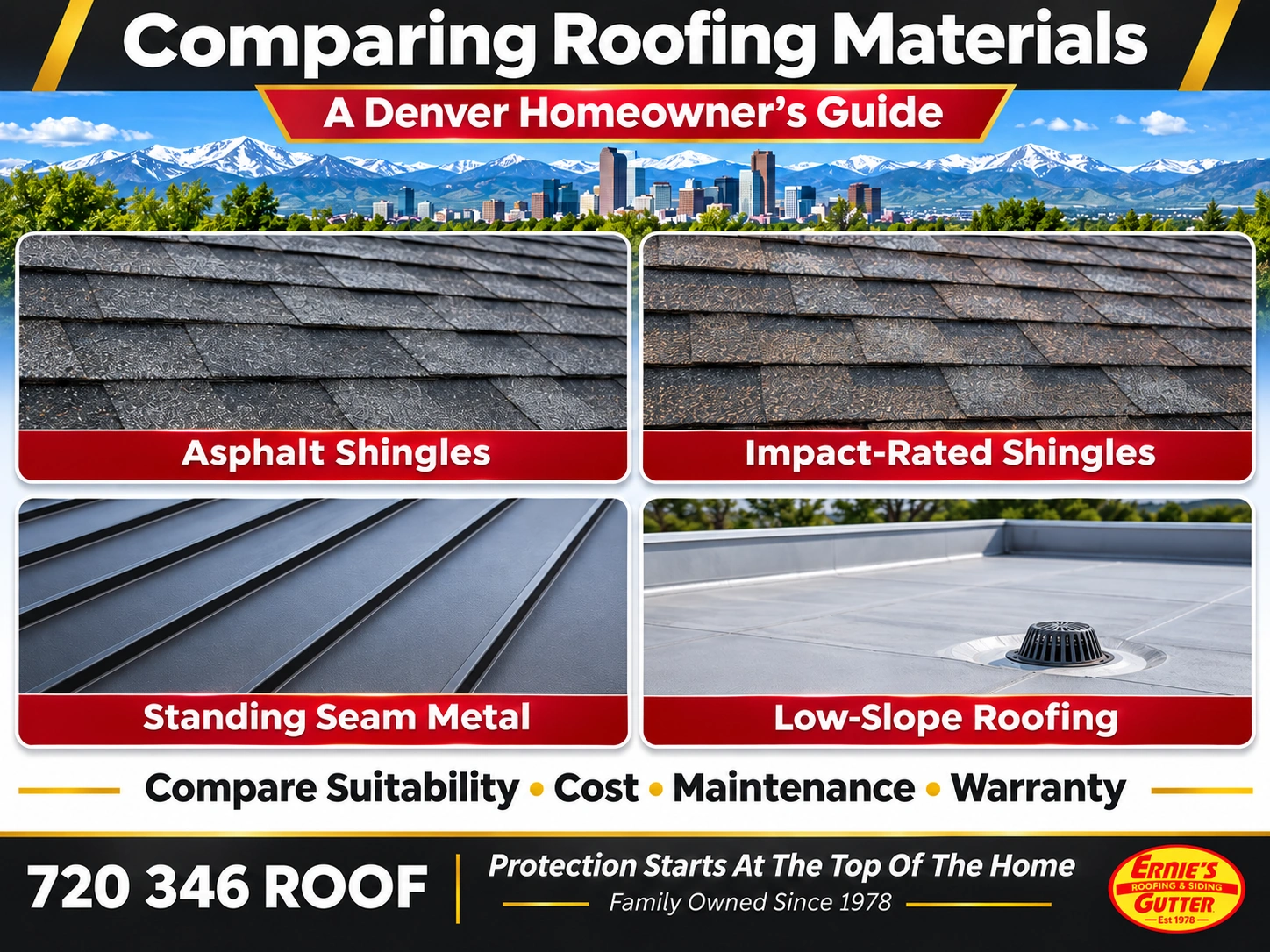
The right roofing material depends on slope, existing conditions, budget, and the complete installation. Asphalt offers familiar options; impact-rated shingles add tested impact performance; standing seam metal requires system-specific detailing; low-slope sections need suitable waterproofing and drainage. Compare exact products, included work, maintenance, and warranty terms before choosing.
Start With the Roof, Then Choose the Material
Meet Ernie’s Roofing. This is our general company introduction. Watch on YouTube.
If this is your first time hearing this, the visible roof covering is only part of the system. Under it are the roof deck, protective layers, fasteners, and details that connect the roof to walls, pipes, chimneys, and drains. A premium surface cannot correct a weak deck or a poorly built transition by itself.
Start by identifying whether you are addressing a localized defect, widespread deterioration, storm damage, or a planned upgrade. Missing shingles or a ceiling stain are visible concerns. The condition beneath the covering may remain uncertain until access or removal makes it possible to investigate.
That distinction affects the budget. Paying for a new covering while leaving an unresolved flashing defect can lead to another leak. Replacing an otherwise serviceable roof solely because a different material sounds better can also be unnecessary. Our roof repair information explains why repair should remain part of the discussion.
For Denver and Front Range homes, compare exposure to hail, sun, snow, wind, and temperature changes alongside roof shape, access, and maintenance. No material name supplies all those answers. The specific product and installation must suit the property.
Comparing Roofing Materials: Four Practical Options
Use this table to organize the conversation. It compares common choices and the questions they raise; it does not rank every product or establish a price for your home.
| Option | Why consider it? | What needs checking? | Cost and upkeep considerations |
|---|---|---|---|
| Asphalt shingles | Familiar appearance and a range of products for suitable sloped roofs | Exact model, permitted slope, fastening, flashing, and ventilation | Often a lower initial cost than standing seam; aging and storm damage still require attention |
| Impact-rated shingles | Asphalt options with documented impact-test performance | Rating, test standard, product instructions, warranty exclusions, and insurer eligibility | Compare the actual upgrade price; any insurance savings must be confirmed with your insurer |
| Standing seam metal | A different roof profile with concealed attachment in many systems | Panel type, seam design, slope approval, movement, penetrations, and snow management | Often a higher initial cost; finish care, detailing, and future repairs matter |
| Low-slope roofing | Membrane or asphaltic systems for roof sections requiring suitable waterproofing | Drainage, deck, insulation, membrane, seams, cover board where specified, and transitions | Area alone does not establish price; drainage and assembly repairs can materially change the scope |
What Each Roofing Choice Means for Your Home
1. Asphalt Shingles
Architectural shingles have a dimensional profile; three-tab products have a different shape and construction. Neither label alone establishes the impact rating, wind coverage, expected service life, or suitability for your roof.
Asphalt may be worth considering when budget, appearance, and compatibility with a suitable existing roof design are priorities. Check the proposed shingle together with underlayment, starter, ridge caps, flashing, and ventilation work.
For repair, matching appearance and safely working with the surrounding shingles matter. A new bundle is not enough if the existing material is too deteriorated to support a dependable repair. Ask what can reasonably be retained.
2. Impact-Rated Shingles
Ernie’s Roofing installs Owens Corning TruDefinition Duration STORM shingles as our Class 4 impact-resistant shingle option. Their WeatherGuard technology uses a reinforcing polymeric backing to help resist impact. See Owens Corning’s Duration STORM product information for manufacturer details.
A local project example: Our South Jeffco roof replacement combined impact-rated shingles with solar panel detach and reset, attic vents, and gutter work. See the South Jeffco before-and-after project in our gallery.
Impact-rated products have documented performance under a specified test. A rating such as Class 4 is useful information, but it does not make the roof hail-proof or establish that hail damage is covered by the material warranty.
Compare the exact model, current rating documentation, installation requirements, and upgrade price. Appearance alone cannot confirm the rating; two similar-looking shingles can have different specifications.
Review our Class 4 impact-resistant shingle guide for that specific choice. Ask your insurer directly whether a selected product qualifies for a discount and what policy conditions apply.
3. Standing Seam Metal
Standing seam uses raised seams between metal panels. Panel design, attachment, seam construction, finish, and roof geometry all affect the system. Snap-lock and mechanically seamed products should not be treated as interchangeable.
Metal can dent in hail. Whether damage is cosmetic, affects performance, or falls within policy coverage requires an assessment of the particular roof and policy. Avoid choosing it on a promise that hail cannot damage it.
Ask how movement, pipes, walls, valleys, and future equipment access will be handled. Where sliding snow could affect doors, walkways, or gutters, discuss a designed snow-retention approach rather than assuming fast snow shedding is always a benefit.
4. Low-Slope Roofing
Porches, additions, garages, and other shallow roof sections may need a different system from the main shingle roof. Common options include modified bitumen and membranes such as TPO or EPDM, selected for the actual assembly.
Modified bitumen uses asphalt-based sheets. TPO is a thermoplastic membrane, and EPDM is a rubber membrane. Their seam, attachment, and accessory details differ. The material name is a starting point, not a complete scope.
Check where water drains, how edges and wall transitions are built, and whether wet or unsuitable underlying materials must be removed. A new membrane does not automatically correct poor slope or a blocked outlet.
South Jeffco Roof Replacement: Before and After

Why This Homeowner Chose Duration STORM
This South Jeffco homeowner chose to upgrade from Oakridge to Duration STORM because her insurance company offered a discount.
Ernie’s Roofing completed the project with impact-rated shingles, solar panel detach and reset, attic vents, and gutter work. The photo shows the roof before replacement and the solar panels back in place.
Choose a Complete Roofing System
Bring your questions about material, roof condition, or competing proposals. We can discuss the property, explain the proposed work, and identify what still needs inspection before a choice is made.
Slope, Drainage, and Structure Come Before Appearance
Pitch describes how steep a roof is. A 4:12 slope rises 4 inches for every 12 inches of horizontal travel. The approved slope range depends on the exact roofing system and its installation instructions.
Some asphalt shingles can be used down to 2:12 with the specified additional protection. That does not make shingles appropriate for every shallow roof or eliminate product-specific restrictions. GAF’s low-slope shingle guidance illustrates why slope and installation details must be checked together.
Standing seam systems also have different minimum slopes. Do not assume every metal panel can be placed on the same low roof. At a change from shingles to membrane, the transition must be designed to keep water moving over the correct layers.
Changing materials can also change attachment, loading, edge details, and how rooftop equipment is supported. The existing structure and deck need to be suitable for the proposed assembly. A poster or color sample cannot establish that suitability.
One House Can Need More Than One System
A home might have a main asphalt-shingle roof and a shallow rear addition using a membrane. A sound proposal can include both. Ask for each section to be measured and specified separately, including the connection between them, rather than forcing one material across every roof surface.
Compare Cost by Included Work
Material choice influences price, but roof area, pitch, access, removal, deck repairs, flashing, drainage, insulation, and equipment coordination can be equally important. A broad online range cannot price those conditions for your house.
When comparing proposals, first confirm that both cover the same roof sections and measurements. Our roofing square guide explains the difference between measured area and material quantities that include cutting allowances.
A Written Comparison Checklist
- Exact product and assembly: manufacturer, model, relevant ratings, and specified protective layers.
- Removal and deck: existing layers, disposal, evaluation of exposed wood, and how additional repairs are authorized.
- Water-control details: edges, valleys, wall and chimney flashing, pipe penetrations, and low-slope outlets where applicable.
- Ventilation or insulation: the proposed work and why it belongs in that roof assembly.
- Site and equipment: access, property protection, rooftop equipment coordination, cleanup, and applicable permit responsibilities.
- Warranty and payment: material coverage, workmanship terms, exclusions, payment schedule, and additional-work approval.
A lower proposal can reflect a better price, different products, or less work. A higher proposal does not automatically prove better installation. Ask for the differences to be explained before choosing.
Think Beyond the Purchase Price
Consider how long you plan to own the home, what maintenance you can arrange, and how future repairs would be handled. Longer advertised service life does not guarantee lower lifetime cost. Storm damage, neglected details, workmanship, and changing needs can alter the calculation.
If full replacement is appropriate, our roof replacement page explains the broader service. This comparison guide helps with material selection; it does not replace a property-specific written scope.
Maintenance, Warranties, and the Long-Term Decision
Plan for Inspection and Repairs
All roof systems need attention to penetrations, edges, drainage paths, and changes made by later trades. Observe from a safe location, keep accessible drains and drainage paths maintained safely, and arrange professional assessment when damage or leakage appears.
On metal, review finish care and incompatible attachments. On membranes, check seam and penetration conditions through appropriate inspections. On shingles, evaluate missing or damaged pieces together with the condition of surrounding materials.
Read the Actual Coverage
A material warranty is different from workmanship coverage. Terms can depend on products, installation, registration, maintenance, exclusions, and transfer conditions. An impact rating is not a substitute for reading those terms.
Review our roofing warranty information alongside the signed agreement and applicable manufacturer documents. Confirm what is covered, who responds, and what process applies if a concern develops.
How We Help Narrow the Choice
We begin with the concern and accessible roof conditions, identify options that fit the property, and explain the work behind each option. Where concealed damage or structural suitability remains uncertain, the scope should identify that uncertainty and the approval process for further work. The goal is a recommendation you can understand, rather than a material selected only by price or appearance.
Insurance Claim Support
When storm damage is involved, distinguish the work needed to address the damage from a voluntary material upgrade. The insurer determines coverage and payment under the policy.
Document the Roofing Findings
Ernie’s Roofing can explain observed roofing conditions and the proposed construction scope. Keep photographs, product information, and work documents together, and clarify which areas and components the scope includes.
Confirm Coverage and Upgrade Costs
Ask the insurer about the selected product, any premium discount, exclusions, and required documentation. Do not assume an upgrade, cosmetic denting, or replacement of undamaged sections is covered. Confirm your financial responsibility before authorizing work.

Ernie Says
A useful material comparison starts with what fits the roof, then explains what you gain, what it costs, and what still needs maintenance. Ask those questions before choosing a color or signing a proposal.
Get a Clear Roofing Recommendation
Ernie’s Roofing has served Denver and the Front Range since 1978. Tell us about your roof, the problem you are seeing, and the choices you are considering so we can discuss the next step.
Roofing Material Comparison FAQs
What is the best roofing material for a Denver home?
There is no single best material for every Denver home. Start with roof slope, existing conditions, budget, appearance, and maintenance needs. Then compare specific products and the complete assembly. A suitable material installed with sound flashing and drainage details is more useful than a premium label on an unsuitable roof.
Are impact-rated shingles different from asphalt shingles?
Impact-rated shingles can be asphalt shingles, including architectural products. The impact designation describes documented test performance rather than a completely separate material. Check the exact model, rating, and installation requirements. Similar-looking shingles can have different specifications, so appearance alone does not establish the rating.
Do Class 4 shingles prevent all hail damage?
No. Class 4 identifies performance under a specified impact test; it does not mean hail-proof. Actual damage depends on the storm, product, condition, and roof assembly. Read the manufacturer’s warranty and ask your insurer about coverage rather than treating the rating as a promise against damage.
Is standing seam metal always better than shingles?
No. Standing seam may suit some budgets, designs, and ownership plans, but its cost, detailing, slope approval, snow management, and future repair needs must be considered. Metal can dent. Asphalt may remain a practical choice for a suitable roof. Compare the particular systems rather than declaring one material universally better.
Can asphalt shingles be used on a low-slope roof?
Some products allow installation down to 2:12 with specified additional protection, but restrictions vary. Confirm the measured slope, current product instructions, and applicable requirements. A roof below the permitted slope needs another suitable system. Adding more shingles or changing their exposure is not a substitute for approved detailing.
What is the difference between TPO, EPDM, and modified bitumen?
TPO is a thermoplastic membrane, EPDM is a rubber membrane, and modified bitumen uses asphalt-based sheets. They have different seam, attachment, and accessory details. Compare the full assembly, including drainage, deck condition, insulation, and protective layers where specified. The product family alone does not establish the right choice.
Will impact-rated roofing lower my insurance premium?
A discount may be available, but eligibility, documentation, products, and policy conditions vary by insurer. Ask your insurer about the exact proposed product before counting on savings. Confirm how any discount relates to coverage and exclusions, and keep the product and installation records your insurer requires.
Why do roofing material proposals have different prices?
The difference can come from product selection, roof measurements, removal, access, deck repairs, flashing, insulation, drainage, and included warranty terms. Compare the same sections and scope before judging the totals. Ask what is excluded and how additional work is approved; price alone does not establish installation quality.
Can one house have shingles and a membrane roof?
Yes. A home may have shingles on the main sloped roof and a suitable membrane on a shallow porch or addition. Each section needs its own specification and appropriate drainage. The connection between systems is important, so ask how that transition will be built and included in the written scope.
Does choosing a new material automatically fix existing leaks?
No. A leak can involve flashing, penetrations, drainage, or concealed conditions that require separate attention. Replacing the surface without addressing the cause may leave the problem unresolved. Begin with an assessment and a written scope that explains the recommended repair or replacement and any conditions that remain uncertain.
Related Reading
- Class 4 impact-resistant shingles
- Roof replacement process and service
- Roof repair and localized roofing problems
- Roofing squares and material quantities
- GAF impact-resistant roofing information and warranty limitations
Ernie’s Roofing • 1195 W Custer Pl, Denver, CO 80223 • 720 346 ROOF