
Solar Powered Attic Vents Denver
Solar Powered Attic Vents in Denver can help move hot attic air when the roof has adequate intake ventilation and the attic needs additional exhaust. Ernie’s Roofing has served Denver since 1978 and evaluates roof design, attic conditions, intake airflow, solar exposure, and vent placement before recommending whether a solar attic vent belongs in the overall ventilation system.
Updated October 2026 • Denver, Colorado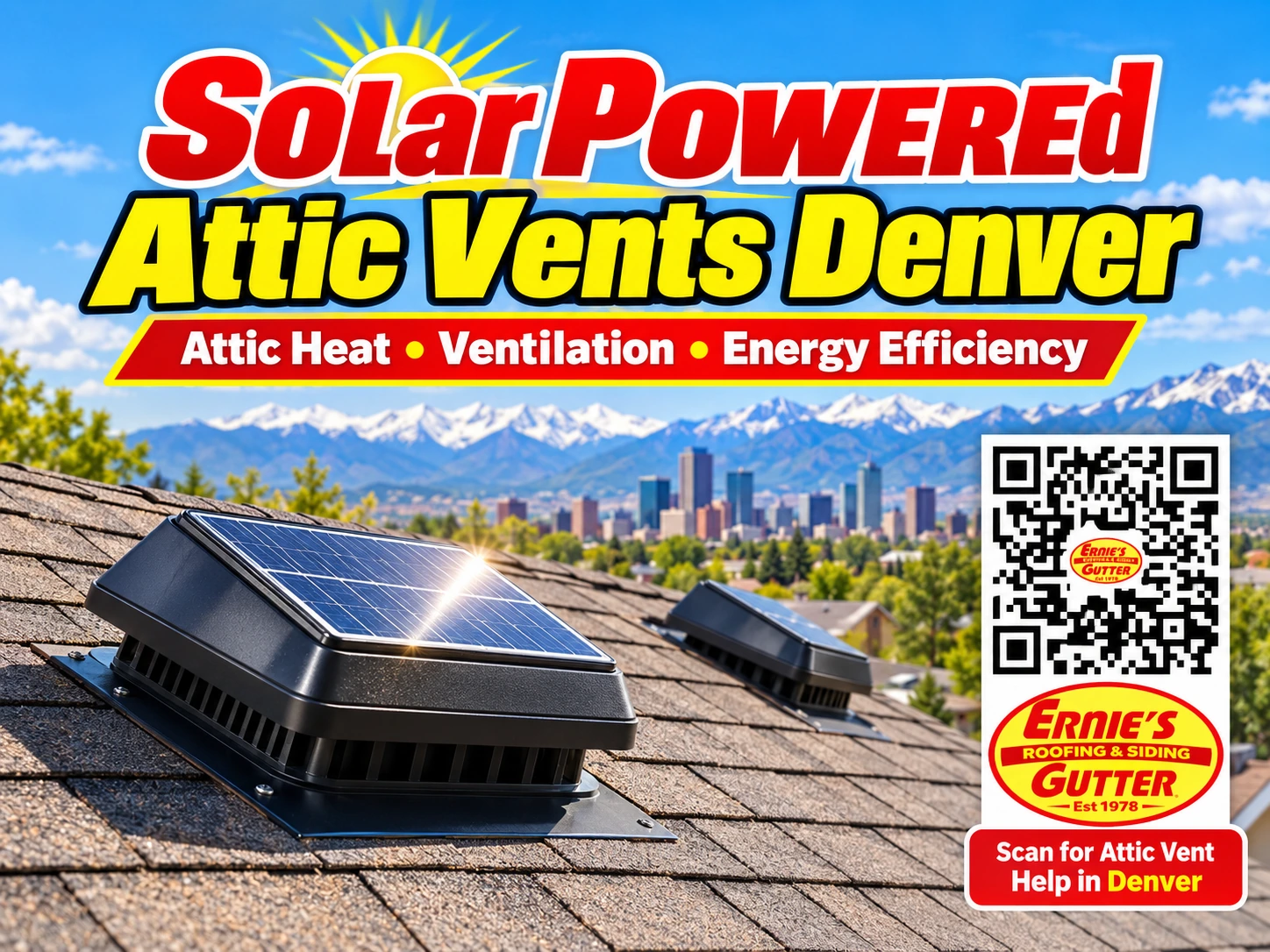
What Do Solar Powered Attic Vents Do?
When Solar Attic Ventilation May Help
A solar vent is not a cure for every hot attic. It may be useful when the attic needs additional exhaust and the rest of the ventilation system can support that airflow.
Hot Attic Air
Solar exhaust can help move heated attic air outside during sunny conditions while the fan is operating.
Limited Passive Exhaust
Some roof designs have limited ridge or static exhaust options and may benefit from another properly designed exhaust method.
Targeted Ventilation Upgrade
Solar Powered Attic Vents may be considered when the existing intake, roof layout, and attic configuration make powered exhaust practical.
Powered Exhaust Still Needs Intake Air
An exhaust fan can only move attic air effectively when replacement air can enter. That means the intake side of the system should be reviewed before adding powered exhaust.
Soffit Intake
Clear soffit vents can provide lower-roof intake when the attic and framing allow air to move upward toward exhaust vents.
Blocked Airflow
Insulation, framing, paint, debris, or missing ventilation channels can restrict intake even when vents are visible outside.
Balanced Airflow
Adding stronger exhaust without considering intake can reduce the effectiveness of the overall attic ventilation system.

“You can put a powerful vent on the roof, but if the attic can’t get enough intake air, the system still isn’t right. Ventilation has to be looked at as a complete airflow path.”
Signs An Attic Ventilation System Should Be Checked
Attic heat alone does not prove the ventilation is wrong, but certain conditions can justify a closer look at how air is entering and leaving the attic.
Solar Powered Attic Vents For Denver Colorado Homes
Denver homes experience strong solar exposure, hot summer roof surfaces, cold winter temperatures, snow, and large temperature swings. Those conditions make attic ventilation and insulation worth evaluating together rather than treating a roof vent as an isolated component.
Solar Powered Attic Vents may be attractive for Denver homes because the fan can operate using available sunlight without relying on a standard household electrical connection at the vent. Actual performance depends on product design, solar exposure, intake ventilation, installation, attic volume, and roof layout.
For additional homeowner guidance on attic ventilation, air sealing, insulation, and energy performance, review information from the U.S. Department of Energy .
Attic Heat And Attic Moisture Are Different Problems
Summer Heat
Sunlight heats the roof surface and attic. Ventilation can move some heated air, while insulation and air sealing also affect heat transfer into the home.
Winter Moisture
Moisture entering the attic from the living space can condense on cold surfaces. Ventilation may help, but indoor humidity and air leakage also matter.
Roof Leaks
Water entering through roofing or flashing is not an attic ventilation problem and should be diagnosed as a roof repair issue.
Solar Vent, Powered Fan, Or Passive Ventilation?
No single attic exhaust method is automatically best for every Denver home. The right approach depends on roof geometry, attic layout, intake ventilation, existing exhaust, and overall roof condition.
Solar Powered Vent
Uses solar energy to operate a fan during suitable daylight conditions.
Electric Powered Fan
Uses electrical power and may include thermostatic or other controls depending on the product.
Passive Ventilation
Ridge vents, static roof vents, and similar exhaust methods rely on natural airflow instead of a powered fan.
Solar Exposure And Roof Placement Matter
Because solar-powered fans depend on available sunlight, roof orientation, shading, nearby trees, chimneys, roof slopes, and other obstructions can affect how much energy reaches the panel.
Vent placement also affects how the unit interacts with existing intake and exhaust vents. Solar Powered Attic Vents should not simply be added wherever there is open roof space without considering the complete attic airflow path.
Our Solar Attic Vent Evaluation Process
What Matters When Choosing A Solar Attic Vent?
Roof Compatibility
The vent and flashing need to integrate properly with the roofing material and roof slope.
Solar Panel Exposure
Shade and roof orientation affect how much solar energy is available to operate the fan.
Manufacturer Requirements
Opening size, flashing, controls, intake requirements, and warranty conditions can vary by manufacturer and model.
Do Solar Powered Attic Vents Save Energy?
Solar Powered Attic Vents do not guarantee a specific reduction in cooling costs. Indoor comfort and energy use depend on insulation, air sealing, HVAC design, roof color, attic temperature, climate, house construction, ventilation, and homeowner use.
The primary job of attic ventilation is to manage airflow. Any energy benefit should be treated as a possible secondary effect rather than a guaranteed result.
Ventilation Is Only One Part Of Attic Performance
A hot or damp attic may involve insulation, air leakage, indoor humidity, roof leaks, blocked intake, or several conditions at the same time. The cause should be evaluated before assuming another fan is the complete solution.
Why Denver Homeowners Call Ernie’s Roofing
Ernie’s Roofing has served Denver since 1978. We evaluate solar attic vents as part of the roofing and ventilation system rather than treating the product as a stand-alone gadget.
Roofing Experience Since 1978
Vent installation affects roofing, flashing, underlayment, and water protection, so roof integration matters.
System-Level Evaluation
Intake, exhaust, attic conditions, solar exposure, and roof layout should all be considered together.
Clear Recommendations
If Solar Powered Attic Vents do not make sense for the roof, another ventilation approach may be more appropriate.
Solar Powered Attic Vents FAQs
What are Solar Powered Attic Vents?
They are roof-mounted exhaust vents that use solar energy to power a fan that moves attic air outdoors when sufficient solar energy is available.
Do solar attic vents need electricity from the house?
A solar-powered vent normally uses its solar panel rather than a conventional household electrical connection at the vent. Product designs vary, so manufacturer instructions should be reviewed.
Do solar attic vents need soffit vents?
They need adequate intake air from an appropriate source. Soffit vents are a common intake method, but the correct intake design depends on the attic and roof configuration.
Will a solar attic vent cool my entire house?
Not by itself. A solar vent moves attic air. Indoor comfort also depends on insulation, air sealing, HVAC performance, windows, solar exposure, and other building conditions.
Can solar attic vents help with attic moisture?
Ventilation can be part of moisture management, but moisture may also come from indoor air leakage, humidity, bathroom exhaust, roof leaks, or other sources.
Where should a solar attic vent be installed?
Placement depends on roof geometry, solar exposure, attic layout, intake locations, existing exhaust vents, roofing material, and manufacturer installation requirements.
Can a solar vent be installed on an existing roof?
Often yes, provided the roofing condition, roof type, flashing method, and installation requirements allow the unit to be integrated correctly.
How many solar attic vents does a house need?
There is no single number that applies to every house. Vent quantity depends on the specific product, attic size, intake capacity, roof design, existing ventilation, and manufacturer instructions.
Are solar attic vents better than ridge vents?
Not automatically. Ridge vents and solar-powered vents use different ventilation approaches. The better option depends on roof geometry, intake ventilation, attic design, and the existing roofing system.
Do Solar Powered Attic Vents work in Denver?
They can be appropriate for some Denver homes when the roof has suitable solar exposure, adequate intake ventilation, proper placement, and an attic configuration that benefits from powered exhaust.
Related Roofing Help
Schedule A Solar Attic Vent Evaluation
If your attic runs hot, ventilation seems limited, or you are considering Solar Powered Attic Vents for a Denver home, start with an evaluation of the roof, attic, intake ventilation, and existing exhaust system.
Information on this page is provided for general roofing, attic ventilation, and homeowner education only. Every roof, attic, ventilation system, insulation system, property, climate exposure, and product is different. Solar powered attic vent performance depends on product design, solar exposure, attic configuration, intake ventilation, installation, roof condition, insulation, air sealing, weather, and other building factors. Energy savings, temperature reduction, moisture control, or other performance results are not guaranteed. Manufacturer instructions, applicable building requirements, and actual site conditions should be reviewed before installation.