
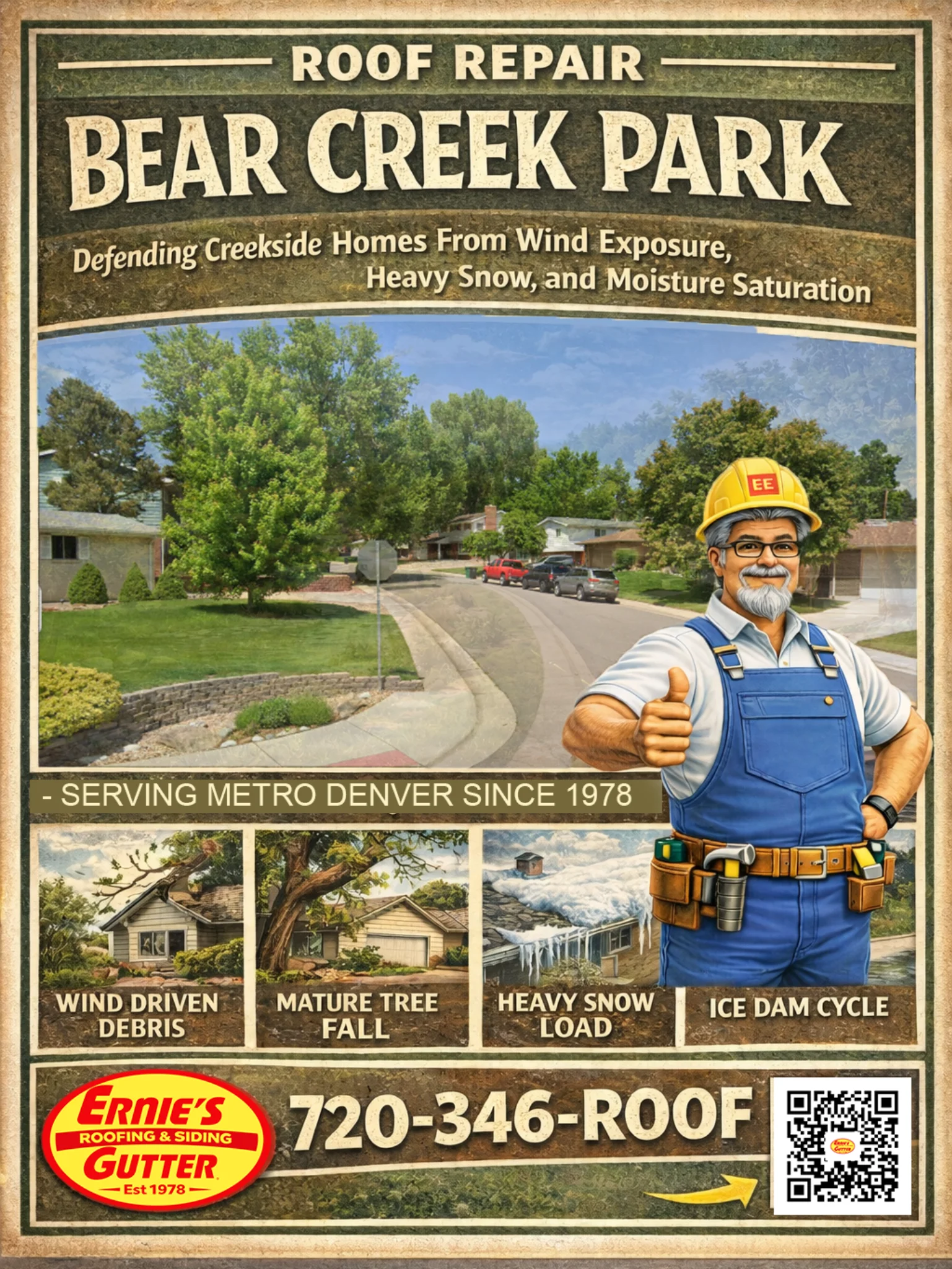
Roof Repair Bear Creek Park, CO | Defending Creekside Homes From Wind Exposure, Heavy Snow, and Moisture Saturation
Roof Repair Bear Creek Park
If you live near Bear Creek Park, roof repair Bear Creek Park, CO is not a cosmetic issue. It is an environmental pressure issue.
Bear Creek Park traces its origins back to the early open land corridors southwest of Denver, with sections of the creek system tied to historic irrigation and settlement routes in the late 1800s. As Denver expanded through the 1950s and 1960s, residential development moved outward toward the natural greenbelts. Homes built along Bear Creek benefited from open space, water access, and tree coverage. But those same features created a unique roofing stress pattern.
Creek corridors create wind channels.
Open greenbelts amplify storm movement.
Mature cottonwoods drop heavy debris.
Shaded rooflines retain moisture longer.
Homes bordering Bear Creek Park experience a different roofing cycle than interior subdivision homes. Wind crosses open park space with little resistance. Snow drifts collect unevenly along roof edges. Freeze thaw cycles intensify where shade meets lingering moisture.
Roof failure here begins quietly.
• Wind loosens seal strips along exposed slopes
• Snow melt backs up at shaded eaves
• Debris collects in valleys and gutters
• Moisture lingers beneath organic buildup
• Flashing begins to separate
• Decking slowly absorbs saturation
By the time staining appears inside, the structural layers have already been compromised.
Environmental Pressure Specific to Bear Creek Corridor
Bear Creek Park is not just open space. It is a wind corridor.
Storm systems moving across the foothills often push eastward through this southwest band. Homes adjacent to the park see:
• Higher sustained wind pressure
• Gust driven uplift at ridge lines
• Uneven snow distribution
• Branch impact from mature trees
• Long moisture dwell times on shaded slopes
Creekside shade slows evaporation. That increases the window for water intrusion at flashing points and nail penetrations.
This is not a standard roof wear pattern.
Escalation Pattern Near Greenbelt Homes
The progression typically follows:
• Wind lift at shingle tabs
• Minor hail bruising weakens mat
• Organic debris traps moisture
• Flashing separates under thermal stress
• Ice forms along eaves
• Deck begins softening
• Interior discoloration follows
Waiting multiplies cost.
Once decking softens, repair becomes partial replacement.
What Most Contractors Miss Near Bear Creek Park
Standard roof repairs often ignore environmental context.
Common oversights:

Roof leaks in Denver often begin long before water appears inside. Discover the real causes of delayed roof leaks and when Denver homes need inspection. Since 1978
• No wind uplift reinforcement
• Failure to install ice and water protection at critical zones
• Ignoring tree debris accumulation
• Reusing aged flashing
• Skipping ventilation recalibration
Homes near open park space require system correction, not surface patching.
A roof is a weather management system. Not just shingles.
Related service: https://erniesroofing.com/emergency-roof-repair-denver/
Snow Load and Ice Formation Risk
Southwest Denver does not see mountain level snow totals, but near creek corridors snow drifts differently.
Risk factors include:
• Uneven accumulation along ridge
• Melt and refreeze cycles
• Shaded north slopes
• Gutter freeze ups
• Backflow beneath shingles
Proper underlayment sequencing and edge protection are critical here.
Drainage and Gutter Integration
Bear Creek homes often sit on slightly sloped lots. Improper gutter flow increases fascia stress and roof edge saturation.
Inspection must include:
• Downspout capacity evaluation
• Gutter pitch verification
• Valley water flow assessment
• Leaf and debris load check
• Fascia integrity inspection
Roof repair without drainage review is incomplete.
Related service: https://erniesroofing.com/seamless-gutters-denver/
When to Act
Schedule inspection if you notice:
• Wind lifted shingle edges
• Tree debris buildup
• Recent hail impact in southwest Denver
• Ice forming at roof edge
• Granule accumulation near downspouts
• Roof age exceeding 15 years
Environmental exposure near Bear Creek Park accelerates deterioration.
Inspection prevents escalation.
720 346 ROOF
Frequently Asked Questions
Was Bear Creek Park part of early Denver expansion?
Yes. Development moved toward the southwest corridor during mid 20th century suburban growth.
Do creek corridors increase wind exposure?
Yes. Open space allows storms to move with less obstruction.
Does tree shade increase roof wear?
It increases moisture dwell time, which can accelerate material breakdown.
Are ice dams common here?
They can form where snow melt refreezes along shaded eaves.
Is decking rot more common near greenbelts?
Moisture retention increases that risk.
Should flashing always be replaced during repair?
On aging systems, yes.
How often should inspections occur?
Annually and after major hail or wind events.
Does open space increase hail vulnerability?
Storm systems often track across open terrain with minimal disruption.
Can debris alone damage a roof?
Trapped moisture under debris can degrade materials over time.
What is the biggest mistake homeowners make?
Waiting until interior staining appears.
Protection starts at the top of the home
This content is provided for general informational and educational purposes only. It does not constitute professional construction, roofing, or contracting advice. Every property, structure, and situation is different. Always consult a qualified roofing or gutter professional for inspections, recommendations, and repairs specific to your home or building.
Related Reading
- Residential Gutter Contractor in Denver
- Why Roof Inspections Matter More in Denver
- Why Roof Valleys Fail on Denver Homes
This content is provided for general informational and educational purposes only. It does not constitute professional construction, roofing, or contracting advice. Every property, structure, and situation is different. Always consult a qualified roofing or gutter professional for inspections, recommendations, and repairs specific to your home or building.
OUR SERVICES
Your Neighborhood Roofing Contractor
Get more information concerning our service, do not wait to call us at 720 346 ROOF today. We’ll be more than happy to schedule a meeting with you.

Residential Roofing Contractor
Ernie’s Roofing specialize in residential roofing in Denver and have a team of experienced professional Roofers available to help you get the job done right The First Time. From minor repairs and maintenance to full–scale roof replacements,

Commercial Roofing
We construct, repair, as well as maintain Commercial Roofing systems for services both large and also small, creating personalized services that conserve our client’s time, cash, and also power. Call us at 720 346 ROOF and book a consultation today.

Hail Damage
Their knowledgeable staff is ready to help you assess the damage caused by storms and provide you with a comprehensive repair evaluation & plan. We specialize in all types of roof damage, including hail, wind, and even lightning strikes. Hail Claim Help

INSURANCE CLAIMS HELP
Our team of experienced insurance claim specialists will work with you to ensure that the insurance claim process is as stress-free as possible. We will work with your insurance company to provide all necessary documentation and estimates to ensure that your claim is processed quickly and correctly.

Wind Damage
When it comes to roof damage, it can be difficult to determine whether the damage was caused by hail or wind. While both types of damage can cause similar symptoms, they have different causes and require different repair methods.